

2026 State of Physical Security Report highlights modernization priorities across the healthcare sector
Healthcare organizations are prioritizing flexible deployment models, artificial intelligence, and stronger collaboration as physical security incidents continue to rise. Insights from global physical security professionals show a sustained shift toward hybrid-cloud systems alongside increased investment in access control, AI-driven analytics, and cross-department integration.
Deployment Flexibility Supports Long-Term Resilience
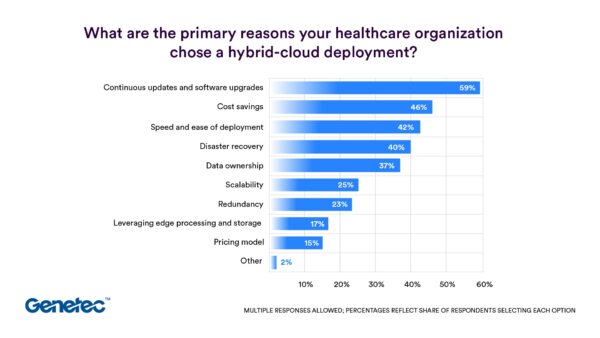
Hybrid-cloud deployments remain the preferred approach for healthcare organizations seeking adaptability and resilience. Continuous updates and software upgrades were cited by 59% of respondents as the primary reason for adopting cloud or hybrid systems. Cost savings (46%) and faster deployment (42%) followed closely. Disaster recovery (40%) and data ownership (37%) further underscore the importance of hybrid models in healthcare environments with complex regulatory and operational requirements.
“Healthcare organizations are taking a measured, strategic approach to modernization,” said Dale Martin, Key Account Manager, Healthcare at Genetec. “Flexible deployment options support long-term planning and goals while allowing organizations to adapt as operational and clinical needs evolve.”
Modernization, AI, And Integration Lead 2026 Priorities
Healthcare organizations identified training and upskilling staff (42%), aging IT infrastructure (40%), and difficulty attracting and retaining talent (38%) as their most pressing challenges. These constraints are shaping how security strategies are defined and executed.
AI adoption continues to accelerate, with 49% of organizations planning to leverage AI to streamline security operations. Access control emerged as the top project priority for 2026 (55%), followed by AI initiatives (40%) and video surveillance upgrades (39%). Collaboration with departments such as human resources and facilities management was also highlighted by 39% of respondents, reflecting the expanding role of physical security across the enterprise.
Rising Incidents Drive Data-Centric Security Operations
The report indicates a notable increase in physical security incidents across healthcare environments. Organizations reported higher rates of physical attacks on employees (55%), verbal assaults (52%), unauthorized entry (50%), break-ins (47%), and insider theft (44%).
In response, healthcare organizations are broadening how security data is shared and consumed. More than half are distributing access activity data from security operations centers to other enterprise systems. Many are also sharing alarms, incident data, video, and audio information, while simultaneously ingesting data from cybersecurity platforms, intrusion and asset monitoring systems, HR tools, and external threat intelligence sources.
Rising Security Incidents Drive Data-Centric Operations
Healthcare organizations are experiencing a noticeable increase in physical security incidents, including physical attacks on employees, verbal assaults, unauthorized entry, break-ins, and insider theft.
In response, security operations centers are expanding how physical security data is shared and integrated across the enterprise. Access activity, alarms, incidents, and video data are increasingly exchanged with other business systems. At the same time, SOCs are ingesting data from cybersecurity platforms, HR systems, asset monitoring tools, and external threat intelligence sources.
Security Data Enables Broader Operational Outcomes
Beyond traditional security functions, healthcare organizations are increasingly using physical security data to support wider operational goals. Key objectives include improving safety and security (60%), enhancing security team efficiency (52%), strengthening regulatory compliance (49%), and improving employee and patient experience (44%). Security data is also being applied to occupancy management and broader operational efficiency initiatives across departments.

Genetec is a global technology company with more than 25 years of experience transforming the physical security industry. Its portfolio includes solutions for video management, access control, ALPR, intrusion detection, intercom, and digital evidence management, all built on a unified, open architecture with cybersecurity at their core.
Internal Links URLs
https://security.world/cloud-security
https://security.world/physical-security
External Links URLs
https://www.genetec.com/industries/healthcare
Frequently Asked Questions (FAQs)
- Why are hybrid-cloud deployments preferred in healthcare security?
Hybrid-cloud models provide flexibility, continuous updates, disaster recovery support, and data ownership while meeting regulatory and operational demands. - How is AI being used in healthcare physical security?
AI is being adopted to streamline security processes, improve incident detection, and enhance operational efficiency across access control and surveillance systems. - What types of security incidents are increasing in healthcare settings?
Organizations are reporting rises in physical attacks, verbal assaults, unauthorized access, break-ins, and insider theft. - How does security data support non-security functions?
Security data is used to improve compliance, optimize occupancy management, enhance operational efficiency, and improve staff and patient experiences.